



Basic Rules of Chicken Road
Chicken Road is one of the most accessible casino games available today. Its rules can be explained in a single sentence: place a bet, guide the chicken across the road one step at a time, and cash out before the run ends. But understanding the rules deeply - the mechanics beneath that simple surface - is what separates players who get consistent results from those who rely on luck alone.
Each round of Chicken Road is governed by a certified Random Number Generator (RNG). Before the round begins, the RNG determines how many steps the chicken can take safely. This outcome is cryptographically sealed and cannot be changed during the round - which is the basis of the Provably Fair system. The player does not know how many safe steps exist, so every step is a decision under genuine uncertainty.
The multiplier starts at 1× when the chicken steps onto the road and increases with every successful step. The rate of increase depends on the difficulty level you chose before the round started. If you cash out voluntarily, you win your stake multiplied by the current value. If the chicken hits an obstacle before you cash out, the round ends and you lose your bet.
There are no cards to count, no patterns to memorise, and no combination of symbols to understand. The only meaningful decision in Chicken Road is: cash out now, or take one more step? That decision, repeated over many rounds, is where strategy, discipline, and risk management come into play.
Step-by-Step Playing Guide
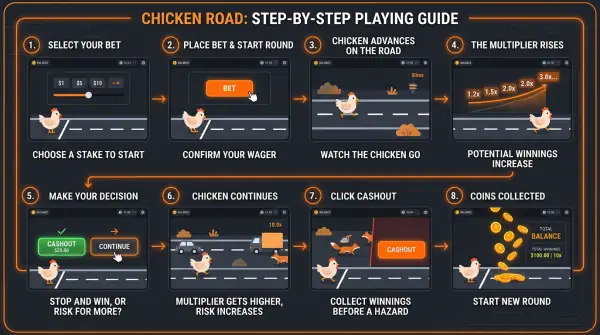
Follow these steps to complete your first real-money round of Chicken Road correctly:
- Open Chicken Road at your chosen casino. Navigate to the crash games or arcade section, search for "Chicken Road" and click to open the game. Make sure you are logged into your casino account with a funded balance.
- Set your bet amount. Use the bet input field to enter your stake in INR. Most casinos allow bets from ₹10 to ₹50,000 per round. For your first sessions, start at the low end - ₹20 to ₹50 per round while you learn the pace.
- Choose your difficulty level. Four options are typically available: Easy, Medium, Hard, and Expert. Each level determines how many hazards appear per step and how quickly the multiplier climbs. Easy is recommended for beginners.
- Click "Play" or "Bet" to start the round. The chicken appears on the road and the multiplier display activates, starting at 1×.
- Watch the chicken advance and the multiplier grow. Each step the chicken takes safely increases the multiplier. The animation shows the path ahead, but you cannot see how many safe steps remain.
- Press "Cash Out" at your chosen moment. The cashout button is prominently displayed during the round. Click it when the multiplier reaches your target to collect winnings: stake × current multiplier.
- If you do not cash out in time and the chicken hits an obstacle, the round ends. You lose your bet for that round. Your balance decreases by the amount staked.
- Review the result and start the next round. Each round is independent - the previous result has no bearing on the next.
The entire cycle from placing a bet to completing a round takes between 10 and 30 seconds depending on how long you stay in the round. This makes Chicken Road one of the fastest-paced casino games - you can play many rounds in a short session, which means both your wins and losses accumulate quickly.
Difficulty Levels - Full Breakdown
Choosing the right difficulty level is the most important decision you make before a round begins. Here is a detailed comparison:
| Difficulty | Risk per Step | Multiplier Growth | Typical Max Safe Steps | Best Cashout Range | Recommended For |
|---|---|---|---|---|---|
| Easy | Low | ~1.1× per step | 10-20+ steps | 1.5× - 3× | Beginners, low-variance play |
| Medium | Moderate | ~1.3× per step | 6-12 steps | 2× - 5× | Intermediate players |
| Hard | High | ~1.6× per step | 4-8 steps | 3× - 10× | Experienced players |
| Expert | Very high | 2×+ per step | 2-5 steps | 5× - 50×+ | High-risk, large multiplier hunting |
A critical misconception among new players is that higher difficulty means worse odds. The overall RTP is approximately equal across all difficulty levels. What changes is variance: Easy produces many small wins; Expert produces rare but potentially very large wins and frequent total losses. Neither is mathematically superior - your choice should reflect your bankroll size and how you prefer to experience the game.
As a practical rule: if your session budget is ₹1,000, Easy or Medium difficulty gives you enough rounds to make the session meaningful. At Expert difficulty with ₹50 bets, you could lose your entire budget in 20 rounds.
Game Interface Explained
Understanding every element of the Chicken Road interface prevents confusion during fast-paced rounds:
Bet Input Field
Located at the bottom of the game screen. Enter your desired stake before each round. Some casinos include quick-select buttons (×2, ÷2, Max, Min) to adjust your bet rapidly without typing. Always confirm the amount before clicking Play.
Difficulty Selector
Usually displayed as a row of buttons or a dropdown menu before round start. Locked during an active round - you cannot change difficulty mid-game. Plan your difficulty choice before clicking Play.
Multiplier Display
The large number visible during an active round showing your current potential win multiplier. It starts at 1.00× and increases with each step. If you cash out when it reads 3.50×, your return is your stake multiplied by 3.50.
Cash Out Button
The most important control in the game. Prominently displayed and large during an active round. Click once to execute the cashout immediately. There is no confirmation dialog - the action is instant, so be deliberate.
Balance Display
Shows your current real-money balance at the casino. Updates after each round. Monitoring your balance across sessions is one of the simplest forms of bankroll management.
Round History
Many casinos display a recent history of multiplier outcomes from previous rounds. While each round is independent and this history has no predictive value, some players use it to calibrate their feel for the current difficulty level.
Provably Fair Verification
Usually accessible via a small icon (a lock or shield) near the game info. Click it to see the cryptographic seed for the round and verify that the outcome was determined before you placed your bet.

Tips for Beginners
- Always start with the demo. Before placing a single real-money bet, spend at least 20-30 rounds in demo mode at your intended difficulty level. Get comfortable with the pace and your cashout reactions.
- Set a session budget before you start. Decide your maximum loss for the session and stop when you reach it. Writing the number down before you open the game makes it harder to rationalise overspending in the moment.
- Use small bets while learning. Playing ₹20 per round instead of ₹500 means you can afford 50 rounds on a ₹1,000 budget. More rounds equals more learning opportunities and less risk of a single bad session wiping you out.
- Pick a target multiplier and stick to it. Before each round, decide at what multiplier you will cash out. If your target is 2×, execute the cashout when the display reaches 2×, regardless of the temptation to hold longer.
- Start on Easy difficulty. The slower multiplier growth on Easy gives you more time to react and less chance of losing the round before you can act. Move to Medium after you have made 50+ successful cashouts at Easy.
- Do not play with money you need. Set a gambling budget entirely separate from savings, bills, and living expenses. Chicken Road is entertainment - it should never put essential finances at risk.
- Take breaks between sessions. Extended play reduces decision quality. If you have been playing for more than 30-45 minutes, close the game and take a break before continuing.
- Track your results. Keep a simple record of sessions - date, duration, starting balance, ending balance. This gives you real data about whether your strategy is working and helps you avoid minimising losses in hindsight.

Common Mistakes to Avoid
- Jumping straight to Expert difficulty. The appeal of high multipliers is understandable, but Expert difficulty at low bankroll sizes leads to rapid depletion. Build experience at lower difficulties first.
- Chasing losses. Raising your bet after consecutive losses to "win it back" is one of the most dangerous patterns in gambling. It compounds losses and can deplete a session budget in minutes.
- Holding too long out of greed. Deciding to cash out at 3× and then holding to 5× because "it feels good" is a discipline failure. The RNG doesn't reward patience - it is indifferent to how long you have held.
- Playing without a set stop-loss. Going in with no defined maximum loss and just "seeing what happens" reliably leads to over-spending. Always set a limit before the session starts.
- Misreading the round history. Previous round outcomes are independent of future outcomes. A string of low multipliers does not mean a high multiplier is "due". The RNG has no memory.
- Ignoring bonus wagering terms. Using a casino bonus for Chicken Road without checking that crash games contribute 100% to wagering can leave you with bonus funds you can never withdraw.
- Playing on unreliable connections. A dropped connection mid-round can cause the round to resolve without your cashout input. Use a stable WiFi or 4G connection when playing for real money.