



What is RTP? A Plain-English Explanation
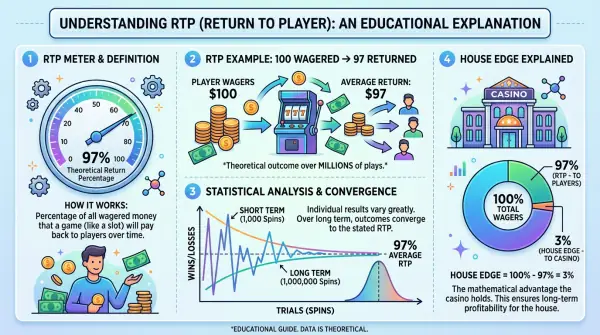
RTP stands for Return to Player. It is a theoretical percentage that describes how much of all money wagered in a game is paid back to players over a very large number of rounds. An RTP of 97% means that for every ₹10,000 bet collectively by all players over millions of rounds, ₹9,700 is returned in winnings, and ₹300 is retained by the house (the house edge of 3%).
There are three critical things to understand about RTP that are frequently misunderstood:
- RTP is a long-run average, not a per-session guarantee. In any single session, your results can deviate dramatically from the stated RTP. You could double your money in 20 rounds or lose 80% of your budget - both are consistent with a 97% long-run RTP. The long-run figure only begins to approximate reality over tens of thousands of rounds.
- Higher RTP means a lower house edge, not more wins. A 97% RTP is better than a 95% RTP for the player, but both still mean the house has a mathematical advantage over time. A higher RTP does not mean you win more often - it means you lose less, on average, over a long period.
- RTP is calculated by the developer, not the casino. The RTP of Chicken Road is built into the game's RNG by Turbo Games. Individual casinos cannot alter the RTP of a licensed game without direct modification of the software, which is prohibited by their licensing agreements and detectable during audits.
Understanding RTP helps you compare games intelligently and set realistic session expectations. It does not predict what will happen in your next round - it describes statistical tendencies across a very large sample size.
Chicken Road RTP - What the Numbers Mean for You
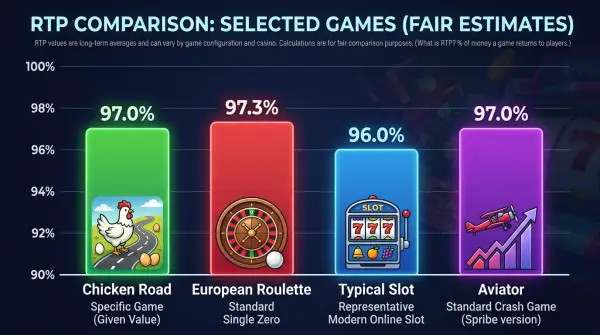
The published average RTP of Chicken Road by Turbo Games is approximately 97%. This places it well above the typical online slot RTP range of 94%-96% and on par with European roulette (~97.3%). In the crash game category, a 97% RTP is competitive and represents one of the better returns available in this game format.
In practical terms, here is what different session lengths and bet sizes look like against a 97% RTP:
| Session Rounds | Bet per Round | Total Wagered | Expected Return (97% RTP) | Expected Loss |
|---|---|---|---|---|
| 50 | ₹50 | ₹2,500 | ₹2,425 | ₹75 |
| 100 | ₹50 | ₹5,000 | ₹4,850 | ₹150 |
| 200 | ₹100 | ₹20,000 | ₹19,400 | ₹600 |
| 500 | ₹100 | ₹50,000 | ₹48,500 | ₹1,500 |
These figures are statistical expectations across many sessions of equivalent size - not predictions for any single session. Variance means individual sessions will differ, sometimes significantly. However, the table illustrates an important point: at 97% RTP, the cost of playing Chicken Road is relatively modest if you manage your session duration and bet size. The house edge is only 3 rupees per 100 wagered - sustainable entertainment if treated as a leisure expense.
Volatility Explained - Low, Medium, High
Volatility (also called variance) describes how winnings are distributed in a game - not how much you win in total over time (that is RTP), but how wins are sized and how frequently they occur. Understanding volatility is essential for choosing the right approach to Chicken Road.
Low Volatility
Many frequent, small wins. Low-volatility gameplay in Chicken Road corresponds to Easy difficulty with early cashouts (1.5×-2×). Your balance fluctuates in small increments - you win often but rarely hit large multipliers. This approach extends session duration and reduces the risk of a large losing streak depleting your budget quickly.
Medium Volatility
A balanced mix of win frequency and win size. Medium difficulty with cashouts in the 3×-5× range produces a moderate level of wins that are meaningful in size without the extreme swings of high-volatility play. This is the most common starting point for Chicken Road players who want variety without high risk.
High Volatility
Infrequent but large wins. Hard and Expert difficulty with target cashouts of 10×-50×+ are high-volatility approaches. Long sequences of total losses are expected and normal - the strategy only pays off when a large multiplier is actually achieved. High-volatility play requires a significantly larger bankroll to weather the dry periods without running out of funds.
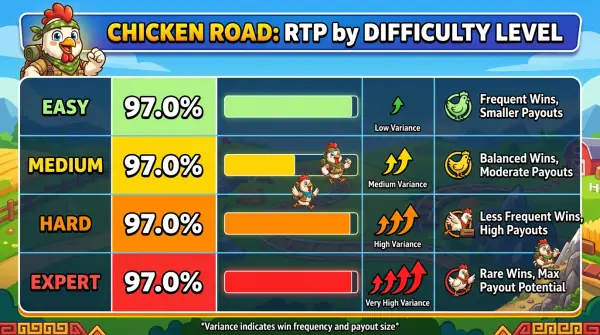
The key insight is that RTP does not determine which volatility level is "better" - they deliver approximately the same mathematical return over time. The choice is about your preferred session experience: steady small wins vs. rare large ones. Neither is objectively superior; both are valid depending on your bankroll and temperament.
RTP & Volatility by Difficulty Level
| Difficulty | Approx. RTP | Volatility | Typical Win Frequency | Win Size Profile | Recommended Bankroll |
|---|---|---|---|---|---|
| Easy | ~97% | Low | High - frequent small wins | 1.5× - 3× | ₹500-₹2,000 |
| Medium | ~97% | Medium | Moderate | 2× - 6× | ₹1,000-₹5,000 |
| Hard | ~97% | High | Lower - less frequent | 5× - 20× | ₹5,000-₹15,000 |
| Expert | ~97% | Very High | Low - rare hits | 10× - 1,000× | ₹10,000+ |
The approximately equal RTP across all difficulty levels is a deliberate design choice by Turbo Games. The game does not reward higher-risk play with a better mathematical return - it rewards it with higher maximum potential wins at the cost of more frequent total losses. This is fundamental to understanding why difficulty selection is a personal preference rather than an objective optimisation.
Comparison with Other Crash Games and Casino Games
How does Chicken Road stack up against other popular games when it comes to RTP and player value?
| Game | Type | Typical RTP | Volatility | House Edge |
|---|---|---|---|---|
| Chicken Road (Turbo Games) | Crash / Arcade | ~97% | Low-Very High (adjustable) | ~3% |
| Aviator (Spribe) | Crash | ~97% | Medium-High | ~3% |
| JetX (Smartsoft) | Crash | ~97% | Medium-High | ~3% |
| European Roulette | Table | 97.3% | Medium | 2.7% |
| Blackjack (basic strategy) | Table | ~99.5% | Low-Medium | ~0.5% |
| Online Slots (typical) | Slots | 94%-96% | Low-Very High | 4%-6% |
| American Roulette | Table | 94.7% | Medium | 5.3% |
Chicken Road's RTP is competitive within the crash game category, matching Aviator and JetX closely. It compares favourably to typical online slots, offering a meaningfully lower house edge (3% vs. 4%-6%). Blackjack with perfect basic strategy has a lower house edge, but it requires strategy memorisation and is a fundamentally different game format. For players who enjoy the crash game mechanic and active decision-making, Chicken Road represents strong value within its category.
How RTP Affects Your Real Chicken Road Session
While RTP is a long-run theoretical figure, it has practical implications for how you plan and experience actual sessions. Here is how to use it constructively:
- Budget for the house edge, not against it. If you play 100 rounds at ₹100 each (₹10,000 total wagered), expect to lose approximately ₹300 (3% house edge) in the long run. Budgeting for this as the cost of entertainment rather than treating it as money "taken" by the casino creates a healthier relationship with the game.
- Shorter sessions reduce variance exposure. The longer you play, the closer your actual results drift toward the theoretical RTP. Shorter sessions mean more variance from the theoretical expectation - meaning both larger-than-expected wins and larger-than-expected losses are more likely per-session. Short sessions increase the chance of a profitable outcome at the cost of potential large losses.
- RTP does not determine individual round outcomes. Knowing the RTP is 97% tells you nothing about what will happen in the next round. Use it for session planning and game selection, not for predicting round results.
- A higher RTP is always preferable, all else being equal. If you are choosing between two crash games with identical features but one has a 97% RTP and the other 95%, the 97% game is the better choice. The difference may seem small but compounds over many rounds: 2% more returned on ₹50,000 of play is ₹1,000.
- Volatility choice should reflect your bankroll. A small bankroll (₹500-₹1,000) is incompatible with high-volatility Expert difficulty play. The variance will likely deplete it before you hit the large multipliers that make Expert worthwhile. Align your volatility choice with a bankroll that can sustain the expected loss runs.