



Bankroll Management - The Foundation of Every Strategy
No strategy in Chicken Road or any other casino game operates independently of your bankroll. Before discussing specific betting approaches, it is essential to understand bankroll management - because without it, every other tactic is built on sand.
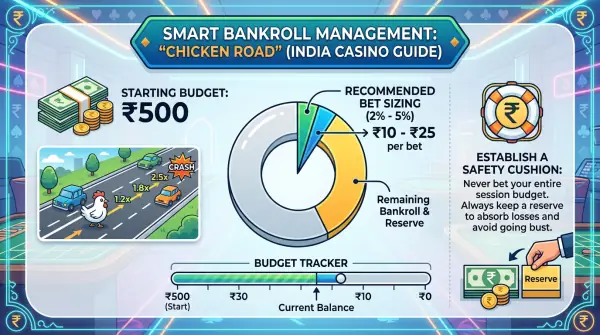
Your bankroll is the total amount of money you have allocated for gambling. It is not your life savings, your salary, or your rent - it is a defined sum you are prepared to lose in the worst case. Setting this boundary before you open the game is the single most impactful decision you make.
Practical bankroll management for Chicken Road involves three numbers:
- Total session bankroll - the maximum you will spend in a single sitting. A common starting point for new players is ₹500-₹2,000 per session.
- Per-round bet size - calculated as 1%-5% of your session bankroll. On a ₹1,000 session budget, this means bets of ₹10-₹50 per round. Smaller percentages extend your session and allow more data points for your strategy.
- Win target - the profit level at which you stop and walk away. Setting a win target prevents the common cycle of winning, then playing until the winnings are gone.
The 2% rule is a practical starting point: bet 2% of your session bankroll per round. On ₹2,000, that is ₹40 per round. This gives you 50 rounds in the worst-case scenario of consecutive total losses - enough to execute a strategy meaningfully.
Risk Level Strategy - Matching Difficulty to Your Goals
Before any betting system, your choice of difficulty level is already a strategic decision. Here is how to match difficulty to your session objective:
| Objective | Recommended Difficulty | Target Cashout Range | Expected Win Frequency | Bankroll Requirement |
|---|---|---|---|---|
| Extend session / learn the game | Easy | 1.5× - 2× | High | Low (₹500-₹1,000) |
| Balanced wins and entertainment | Medium | 2× - 4× | Moderate | Medium (₹1,000-₹3,000) |
| Higher variance, larger wins | Hard | 5× - 15× | Lower | Higher (₹3,000-₹10,000) |
| High-risk multiplier hunting | Expert | 10× - 100×+ | Low | Large (₹10,000+) |
The table above is a guide, not a guarantee. The RNG is indifferent to your objectives - it produces outcomes based on mathematical probability. But aligning your expectations with the statistical reality of each difficulty level prevents frustration and encourages rational cashout decisions.
Martingale Strategy
The Martingale is one of the oldest betting systems in casino history and is frequently applied to crash games. The logic is simple: after every losing round, double your bet. When you eventually win, the win covers all previous losses and yields one unit of profit. Then reset to your base bet.
Example in Rupees (base bet ₹50, target cashout 2×)
| Round | Bet | Result | Net P&L |
|---|---|---|---|
| 1 | ₹50 | Loss (did not reach 2×) | −₹50 |
| 2 | ₹100 | Loss | −₹150 |
| 3 | ₹200 | Loss | −₹350 |
| 4 | ₹400 | Win (cashed out at 2×) | +₹50 net |
The Martingale works in theory but breaks down in two critical real-world scenarios:
- Losing streaks are longer than expected. Six consecutive losses at a ₹50 base requires a bet of ₹3,200 on round 7. Ten consecutive losses require ₹51,200. Streaks of this length are rare but not impossible - and when they happen, they wipe out entire session bankrolls.
- Casino maximum bet limits. Most casinos cap individual round bets at ₹10,000-₹50,000. If a Martingale escalation reaches the cap, the system breaks - you cannot recover all losses from the next win.
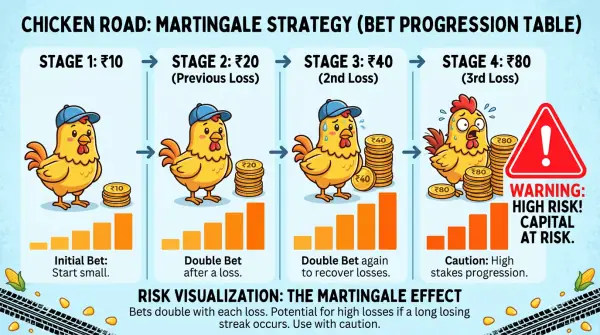
The Martingale is most safely applied with a low base bet (1%-2% of your total bankroll), a modest cashout target (1.5×-2×), and a strict stop at 5-6 consecutive losses regardless of the theoretical expectation.
Anti-Martingale (Reverse Martingale) Strategy
The Anti-Martingale inverts the logic: double your bet after a win, return to base after a loss. The goal is to exploit winning streaks for compounded gains while limiting the damage of losing rounds to the base bet only.
In Chicken Road, an Anti-Martingale session might look like this: you start with ₹50, cash out at 2×, win. You raise to ₹100 on the next round - if you win again, you raise to ₹200. If you lose at any point, you return to ₹50.
The advantage of this approach is that you are never risking accumulated profit from previous rounds on a raised bet - you are only ever risking one unit of profit from the immediately preceding win. The disadvantage is that winning streaks in Chicken Road are shorter and less predictable than players hope, so the escalation rarely reaches significant heights before a loss resets it.
Anti-Martingale works best at Easy or Medium difficulty where cashout success is more frequent, providing more opportunities to escalate safely. At Expert difficulty, consecutive wins are rare enough that the escalation rarely progresses meaningfully.
Conservative Flat-Bet Strategy
The conservative strategy is the most sustainable long-term approach to Chicken Road. It involves three fixed parameters agreed upon before the session starts, and strict adherence to them throughout:
- Fixed bet amount - the same stake every round, typically 1%-2% of session bankroll.
- Fixed cashout target - a multiplier you cash out at every time, typically 1.5× to 3×.
- Fixed session stop rules - stop at a set loss limit (e.g., −30% of session bankroll) or a set profit target (e.g., +50% of session bankroll).
A conservative session at Easy difficulty targeting 1.5× cashout and a ₹50 flat bet on a ₹2,500 bankroll produces a net gain of ₹25 per successful round and a loss of ₹50 per failed round. The strategy is not designed to generate large wins - it is designed to produce steady, small gains and control the rate of loss, extending session time and reducing variance.
The conservative strategy is particularly suited to players using casino bonuses, where consistent small bets across many rounds is the most efficient way to meet wagering requirements without exposing the bankroll to high-variance swings.
Choosing Your Cashout Target
Regardless of which betting system you use, the cashout target is the most consequential tactical choice in every round. Here is how different targets affect the math:
- 1.5× cashout: Needs to win roughly 2 out of every 3 rounds to be profitable. Achievable at Easy difficulty with consistent play, but leaves little room for losing streaks.
- 2× cashout: Needs to win more than 1 in 2 rounds to be profitable. A common and sustainable target at Easy to Medium difficulty.
- 3× cashout: Needs to win roughly 1 in 3 rounds. Works well at Medium to Hard difficulty where fewer but larger wins are expected.
- 10× cashout: Needs to win 1 in 10 rounds to break even. Viable only at Hard or Expert difficulty. High variance means long loss runs before a significant win.
- 50×+ cashout: Very rare events. Playing for these multipliers is fundamentally a high-stakes lottery within the game and requires a correspondingly large bankroll to survive until a hit.
There is no universally "correct" cashout target - the best choice depends on your difficulty level, bankroll size, and risk tolerance. What matters most is picking a target and sticking to it every round, rather than changing mid-session based on how recent rounds have gone.
Psychology & Discipline - The Real Edge
Every strategy in this guide is only as good as your ability to follow it under pressure. Chicken Road's fast pace and real-money stakes create psychological conditions that undermine rational decision-making. Understanding these patterns is as important as understanding the strategies themselves.
The Gambler's Fallacy
The belief that after a string of losses, a win is "due". In Chicken Road, each round is completely independent - the RNG has no memory. Ten consecutive losses do not increase the probability of a win on round eleven. Acting as though they do leads to irrational bet escalation and compounded losses.
Loss Chasing
Raising bets after losses to recover previous losses faster. This is one of the most destructive patterns in crash game play. A disciplined player accepts losses as part of the variance and maintains their planned bet size regardless of preceding results.
Greed at High Multipliers
Deciding to cash out at 5× and then holding to 8× because "it feels right" is a failure of discipline. The multiplier display creates an emotional pull - the higher it climbs, the more painful it feels to stop. Practise pre-committing to your cashout target before the round starts, not during it.
Tilt
Emotional state after significant losses where rational thinking gives way to impulsive decisions. If you notice yourself raising bets significantly, abandoning your strategy, or playing faster than usual, stop the session. Log out, take a walk, and return when you are in a neutral emotional state.

The players who consistently get the most from Chicken Road are not those with the most sophisticated betting systems - they are those with the most reliable discipline. Strategy without discipline is theory; strategy with discipline is practice.